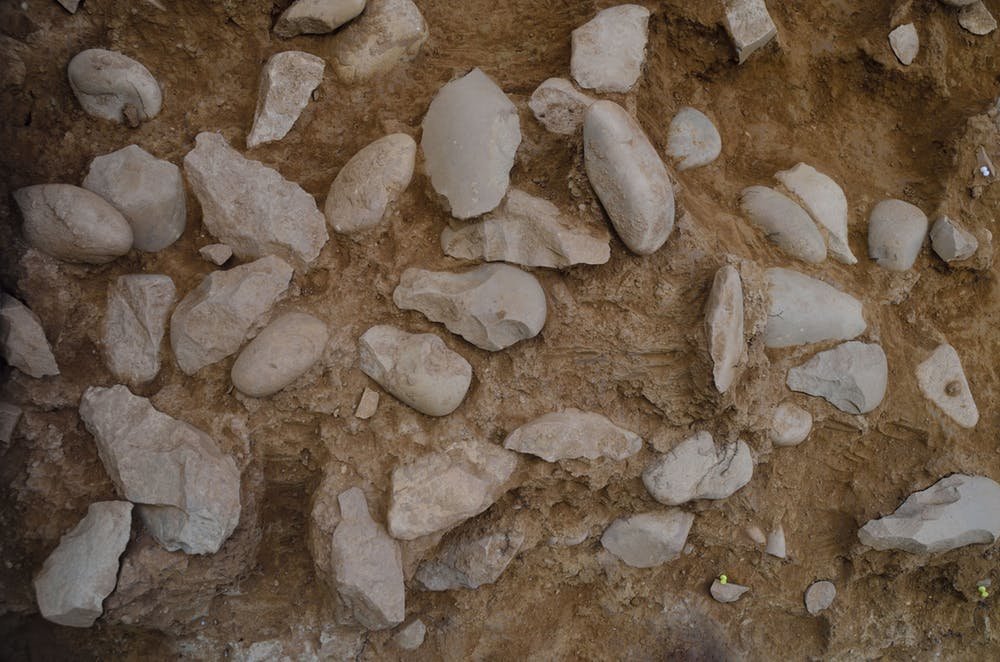
Geochronologists from the Centro Nacional de Investigación sobre la Evolución Humana (CENIEH) have led a study published in the journal Quaternary Geochronology about the chronology of the archaeological site of Gran Dolina, situated in the Sierra de Atapuerca (Burgos), whose results confirm a pulse of human dispersion in southern Europe around one million years ago..
TD4 Level at Gran Dolina site [Credit: CENIEH]
This is a paleomagnetic study of the lower stratigraphic levels of this archaeological site in Burgos, whose objective was to determine the possible presence of the Jaramillo subchron, a geological event of normal magnetic polarity about one million years ago, to improve the chronological framework for the lithic industry found at level TD4, and therefore for human presence in Atapuerca.
"Gran Dolina is one of the sites with the best-preserved sedimentary records of the Middle and Early Pleistocene in Europe, and therefore, knowing the chronology of the stratigraphic levels comprising it is an extremely important element in understanding the presence and development of human activity in the zone," explains Claudia Álvarez Posada, lead author of this paper.
Samples from the levels TD4 to TD6 were analyzed using paleomagnetism, a methodology which is increasingly used for establishing absolute datings given its great versatility and the fact that it has an extremely wide chronological register, because the magnetic field remains captured in sediments when they are formed. These days there is a known register covering a timeline of over 180 million years up to the present, so that as Álvarez affirms, "it's a very powerful tool for chronology."
This method, together with the data furnished by biostratigraphy and the recent dating studies using Electron Spin Resonance (ESR) made at the site, has allowed an age later than the Jaramillo Subchron to be definitively established for the level TD4, that is, less than one million years, consistent with with a pulse of human dispersal across southern Europe during the time interval known as the Lower Pleistocene transition.
Dual study
This paper forms part of a dual paleomagnetic study of Gran Dolina, encompassing levels TD1 to TD6, undertaken for better understanding of the ages of the different stratigraphic levels which comprise the fillings of the site.
The second paper, which has just been published in the journal Quaternary Science Reviews, focuses on the chronology of the lower sedimentary fillings, and corroborates the datings found for TD4.
Over 41 000 cultural goods such as coins, paintings and drawings, furniture and musical instruments, porcelain, archaeological and paleontological objects, books and manuscripts and sculptures were seized all over the world as a result of coordinated law enforcement actions. These seizures were made during the first Global Global Customs-Police Operation, codenamed ATHENA and organised by the World Customs Organisation (WCO) in cooperation with INTERPOL, and during the regional Europe-focused Operation PANDORA II, coordinated by the Spanish Guardia Civil and Europol.
Credit: Europol
Both operations took place from October to early December 2017, with a common action phase from 20 to 30 November 2017, and saw the involvement of customs and police forces from 81 countries. Both, ATHENA and PANDORA II, focused on the illicit trafficking of cultural objects, theft, looting as well as internet sales. Most of the actions were developed and coordinated jointly between Customs and Police on the national level with the support and participation of the experts from the Ministries of Culture and other relevant institutions and law enforcement agencies.
Apart from seizures, there have been tens of thousands of checks and controls in various airports, ports, other border crossing points, as well as in the auction houses, museums and private houses. As a result, more than 200 investigations were opened and 53 persons arrested.
Credit: Europol
Given the global nature of this crime, operation coordination units working 24/7 were established by Europol on one side, and the WCO and INTERPOL on the other, to support the exchange of information as well as disseminate alerts, warnings and perform cross- checks in different international and national databases.
Internet as a facilitator for the illicit trafficking of cultural goods
Internet has changed, as in many other fields of our society, the traditional chains of the illicit trade of cultural goods. It is a new challenge for law enforcement authorities especially for the specialized cultural goods crime units. Now the criminals can reach the collector’s (anywhere in the world) without any intermediate, and out of the traditional channels.
Credit: Europol
Facing this threat, the involved law enforcement agencies monitored thousands of market places, internet announcement has in order to detect and seize looted or stolen cultural goods. Only in this area, 63 new criminal investigations have been opened and more than 6 000 cultural objects have been seized.
In a single successful investigation in Spain, Guardia Civil seized more than 2 000 cultural objects. Most of them were coins from Roman and other Empires and archaeological objects made of ceramic, metal and stone. In addition, 88 pieces of ivory were seized during the searches, including a carving of Christ valued at EUR 6 000 , and 39 firearms of different classification, from historical weapons, such as rifles and shotguns, swords, swords, katanas and a crossbow, revolvers and pistols. The investigation started with the checks of various internet pages dedicated to the sale and purchase of objects of historical value, and is still ongoing.
The Hellenic Police conducted a fruitful investigation in the framework of PANDORA II: during the searches in two residences and in two businesses of a national entrepreneur, they found 41 archaeological objects, for which the collector did not have a corresponding license. Additionally, from a legal collection of 1 133 coins of silver, bronze and gold of the 2nd century B.C. until 200 A.C., 15 coins were missing, and from a legal collection of 105 ancient objects, 26 objects were missing. All the possessed objects of archaeological and cultural value were confiscated, namely 1 252 cultural goods.
In an ancient DNA study published this week in the journal Nature, scientists and archaeologists from over 80 different institutions lift the veil on the genomic history of Southeastern Europe, a region from which very little ancient genetic data has been available until now. This is the second-largest ancient DNA study ever reported. (The largest, reported simultaneously in Nature by many of the same authors, focuses on the prehistory of Northwestern Europe.)
Starting around 8,500 years ago, agriculture spread into Europe from the southeast, accompanied by a movement of people from Anatolia. This study reports data from the genomes of 225 ancient people who lived both before and after this transition, and documents the interaction and mixing of these two genetically different groups of people. “Southeastern Europe was the beachhead in the spread of farming from Anatolia into Europe. This study is the first to provide a rich genetic characterization of this process by showing how the indigenous population interacted with incoming Asian immigrants at this extraordinary moment in the past,” says Songül Alpaslan-Roodenberg, a consulting anthropologist at Harvard Medical School, who identified and sampled many of the skeletons.
“In some places, hunter-gatherers and incoming farmers seem to have mixed very quickly,” says first author Iain Mathieson, a geneticist at the University of Pennsylvania, “but mostly the two groups remained isolated, at least for the first few hundred years. These hunter-gatherers had been living there for thousands of years, and it must have been quite a shock to have these new people show up—with a completely different lifestyle and appearance.”
“Three thousand years later, they were thoroughly mixed,” continues David Reich of Harvard Medical School, the Broad Institute of MIT and Harvard and the Howard Hughes Medical Institute, who co-directed the study. “Some populations derived up to a quarter of their ancestry from hunter-gatherers.” In other parts of Europe, this mixing was marked by a so-called sex bias, with most of the hunter-gatherer ancestry contributed by men. In the southeast, however, the pattern was different. “This shows that the mode of interaction between the two groups was different in different places, something we need to try to understand in the context of the archaeological evidence,” added Mathieson.
The new paper also dramatically increases the number of samples from the population of hunter-gatherers that inhabited Europe before the farmers. The study reports a particularly rich sampling of forty hunter-gatherers and early farmers from six archaeological sites from the Iron Gates region, which straddles the border of present-day Romania and Serbia. The genetic results show that the region witnessed intensive interaction between hunter-gatherers and farmers. Out of four individuals from the site of Lepenski Vir, for example, two had entirely Anatolian farmer-related ancestry, fitting with isotope evidence that they were migrants from outside the Iron Gates region, while a third individual had a mixture of ancestries and consumed aquatic resources, as expected if farmers were being integrated into hunter-gatherer groups or were adopting a hunter-gatherer lifestyle.
“These results reveal the relationship between migrations, admixture and subsistence in the this key region and show that even within early European farmers, individuals differed in their ancestry, reflecting a dynamic mosaic of hunter-farmer interbreeding,” adds Ron Pinhasi, an anthropologist at the University for Vienna, who co-directed the study.
The new paper also reports ancient DNA from the people who lived at iconic archaeological sites such as Varna, one of the first places in the world where there is evidence of extreme wealth inequality, with one individual from whom the study obtained data buried with more gold than all other known burials of the period. “The DNA from the famous Varna burial is genetically similar to that of other early European farmers. However, we also find one individual from Varna and several individuals at neighboring sites in Bulgaria who had ancestry from the eastern European steppe. This is the earliest evidence of steppe ancestry this far west—two thousand years before the mass migration from the steppe that replaced more than half of the population of northern Europe,” says Johannes Krause, Director of the Department of Archaeogenetics at the Max Planck Institute for the Science of Human History, who led the work on Varna.
Adds Reich, “These very large ancient DNA studies, involving intense collaboration between geneticists and archaeologists, make it possible to build up a rich picture of key periods of the past that could only be weakly glimpsed before. Studies on this scale represent a coming of age for the field of ancient DNA—I look forward to what we will learn when similar approaches are applied elsewhere in the world.”
Even our earliest human ancestors made and used technology - something we can look back on thanks to the lasting nature of stone tools.
Researchers work on the archaeological site in Spain, known as Porto Maior, where the tool deposits were found [Credit: Eduardo Méndez Quintas, Author provided]
An exceptionally high density of giant handaxes dated to 200,000-300,000 years ago has been uncovered at an archaeological site in Galicia, northwest Spain. The findings are documented in a new article published by our international research team of archaeologists and dating specialists.
The discovery of these handaxes suggests that alternative types of stone tool technologies were simultaneously being used by different populations in this area – supporting the idea that a prehistoric “Game of Thrones” scenario existed as Neanderthals emerged in Europe.
Additional evidence for this idea comes from fossil records showing that multiple human lineages lived in southwest Europe around the same time period.
Stone tool technology
Porto Maior is near the town of As Neves (Pontevedra, Galcia) on a terrace 34m above the current level of the Miño River, which borders northern Portugal and Spain.
The large tools are consistent with a culture known as Acheulean [Credit: Eduardo Mendez Quintas, Author provided]
The archaeological site at Porto Maior preserves an ancient stone tool culture known as the Acheulean. Characterised by symmetrically knapped stones or large flakes (known as bifaces), the Acheulean is the first sophisticated handaxe technology known in the early human settlement record of Europe.
While Acheulean sites are widespread across the continent, Porto Maior represents Europe’s first extensive accumulation of large cutting tools (LCTs) in the Acheulean tradition. Until now, such high densities of LCTs had only been found in Africa. This new finding reinforces an African origin for the Acheulean in Europe, and confirms an overlap in time-frames of distinctly different stone tool cultures on the continent.
At around the same time that handaxes were being used at Porto Maior, a different stone tool tradition (the Early Middle Palaeolithic) was present in Iberia, for example at Ambrona and Cuesta de la Bajada. In central and eastern Europe – where tools were made exclusively on small flakes – the Acheulean tradition has never been found.
Porto Maior introduces further complexity to this overlapping technological pattern, and suggests that distinct early human populations of different geographical origins coexisted during the Middle Pleistocene (between 773,000 and 125,000 years ago).
Abundant large cutting tools
In total, 3,698 discarded artefacts were recovered from river-lain sediments at the site, with 290 of these making up the studied assemblage reported in our new paper.
The stone tool assemblage is composed of 101 LCTs in original position, and that are on average 18cm long, with a maximum length of 27cm. These handaxe dimensions are exceptionally large by European Acheulean standards (typically only 8-15cm long). The assemblage also contains large cleavers, a type of tool typically found in African sites.
At 9.5 pieces per m² in an excavated area of more than 11.8m², the density of the Acheulean stone tool accumulation is one of the highest recorded globally, surpassing previous European findings of smaller Acheulean tools (usually less than 3 artefacts per m²).
Laboratory analyses indicate that the tools were used to process hard materials such wood and bone, in activities that could have included the breaking up of carcasses.
The Spanish site of Porto Maior clearly resembles extensive accumulations of very large tools previously only seen in Africa and the Near East. These similarities reinforce the idea of an African origin for the Acheulean tradition of southwest Europe.
They also raise new questions regarding the origin and mobility of prehistoric human populations – the ancestors of Neanderthals – that occupied the European continent during the Middle Pleistocene period before the arrival of our own species, Homo sapiens.
Luminescence dating samples being measured under controlled lighting conditions at the University of Adelaide’s Prescott Environmental Luminescence Laboratory [Credit: Lee Arnold]
These techniques provide an estimate of the last time sand grains within sediments were exposed to sunlight, by looking at their luminescence or paramagnetic properties – that is, they can tell us the timing of sediment burial. This, in turn, can be used to determine when the site was last occupied and when the artefacts discarded by prehistoric populations were subsequently buried by sediment accumulation.
In the study of Porto Maior, pIR-IRSL and ESR dating were applied to grains that had been carefully collected from the sediment layers hosting the stone tools, without exposing the sample material to daylight.
The two methods, which were applied independently at two different Australian institutions (University of Adelaide and Griffith University), produced remarkably similar ages.
This confirms the reliability of the dating results, and indicates that the archaeological record spanned the time period from 200,000 to 300,000 years ago.
Migration from Africa
The Acheulean tool-making tradition originated in Africa about 1.7 million years ago, and disappeared on that continent by 500,000 years ago. The specific type of Acheulean tools described at Porto Maior is exclusive to southwest Europe, suggesting that the technology was brought into the region by an “intrusive” population.
Acheulean tools in their primary position at Porto Maior, Spain [Credit: Eduardo Mendez-Quintas, CC BY]
The age of Porto Maior is consistent with previous findings from Iberia that suggest that the Acheulean culture experienced an expansion in the region between 400,000 to 200,000 years ago.
This latest discovery supports the increasingly complex narrative developing from ongoing studies of human fossils from Europe; namely that human groups of potentially different origins and evolutionary stages coexisted across the continent during a time when the emergence of Neanderthals was taking place.
While it is clear that more human fossil and stone tool sites need to be reliably dated across the region, a picture appears to be emerging of a turbulent “Game of Thrones” style scenario of hominin evolution in Eurasia during the Middle Pleistocene period.
Scientists have found the first major evidence that Neanderthals, rather than modern humans, created the world's oldest known cave paintings -- suggesting they may have had an artistic sense similar to our own.
Panel 3 in Maltravieso Cave showing 3 hand stencils (centre right, centre top and top left). One has been dated to at least 66,000 years ago and must have been made by a Neanderthal (colour enhanced) [Credit: H. Collado]
A new study led by the University of Southampton and the Max Planck Institute for Evolutionary Anthropology shows that paintings in three caves in Spain were created more than 64,000 years ago -- 20,000 years before modern humans arrived in Europe.
This means that the Palaeolithic (Ice Age) cave art -- including pictures of animals, dots and geometric signs -- must have been made by Neanderthals, a 'sister' species to Homo sapiens, and Europe's sole human inhabitants at the time.
It also indicates that they thought symbolically, like modern humans.
Published in the journal Science, the study reveals how an international team of scientists used a state-of-the-art technique called uranium-thorium dating to fix the age of the paintings as more than 64,000 years.
Until now, cave art has been attributed entirely to modern humans, as claims to a possible Neanderthal origin have been hampered by imprecise dating techniques. However, uranium-thorium dating provides much more reliable results than methods such as radiocarbon dating, which can give false age estimates.
Panel 78 in La Pasiega. The scalariform (ladder shape) composed of red horizontal and vertical lines dates to older than 64,000 years and was made by Neanderthals [Credit: C.D Standish, A.W.G. Pike and D.L. Hoffmann]
The uranium-thorium method involves dating tiny carbonate deposits that have built up on top of the cave paintings. These contain traces of the radioactive elements uranium and thorium, which indicate when the deposits formed -- and therefore give a minimum age for whatever lies beneath.
Joint lead author Dr Chris Standish, an archaeologist at the University of Southampton, said: "This is an incredibly exciting discovery which suggests Neanderthals were much more sophisticated than is popularly believed.
"Our results show that the paintings we dated are, by far, the oldest known cave art in the world, and were created at least 20,000 years before modern humans arrived in Europe from Africa -- therefore they must have been painted by Neanderthals."
A team of researchers from the UK, Germany, Spain and France analysed more than 60 carbonate samples from three cave sites in Spain -- La Pasiega (north-eastern Spain), Maltravieso (western Spain) and Ardales (south-western Spain).
All three caves contain red (ochre) or black paintings of groups of animals, dots and geometric signs, as well as hand stencils, hand prints and engravings.
According to the researchers, creating the art must have involved such sophisticated behaviour as the choosing of a location, planning of light source and mixing of pigments.
Alistair Pike, Professor of Archaeological Sciences at the University of Southampton and co-director of the study, said: "Soon after the discovery of the first of their fossils in the 19th century, Neanderthals were portrayed as brutish and uncultured, incapable of art and symbolic behaviour, and some of these views persist today.
"The issue of just how human-like Neanderthals behaved is a hotly debated issue. Our findings will make a significant contribution to that debate."
Joint lead author Dirk Hoffmann, of the Max Planck Institute for Evolutionary Anthropology, added that symbolic material culture -- a collection of cultural and intellectual achievements handed down from generation to generation -- has, until now, only been attributed to our species.
Drawing of Panel 78 in La Pasiega by Breuil et al (1913). The red scalariform (ladder) symbol has a minimum age of 64,000 years but it is unclear if the animals and other symbols were painted later [Credit: Breuil et al.]
"The emergence of symbolic material culture represents a fundamental threshold in the evolution of humankind. It is one of the main pillars of what makes us human," he said.
"Artefacts whose functional value lies not so much in their practical but rather in their symbolic use are proxies for fundamental aspects of human cognition as we know it."
Early symbolic artefacts, dating back 70,000 years, have been found in Africa but are associated with modern humans.
Other artefacts including cave art, sculpted figures, decorated bone tools and jewellery have been found in Europe, dating back 40,000 years. But researchers have concluded that these artefacts must have been created by modern humans who were spreading across Europe after their arrival from Africa.
There is evidence that Neanderthals in Europe used body ornamentation around 40,000 to 45,000 years ago, but many researchers have suggested this was inspired by modern humans who at the time had just arrived in Europe.
Study co-author Paul Pettitt, of Durham University, commented: "Neanderthals created meaningful symbols in meaningful places. The art is not a one-off accident.
"We have examples in three caves 700km apart, and evidence that it was a long-lived tradition. It is quite possible that similar cave art in other caves in Western Europe is of Neanderthal origin as well."
New archaeological finds unearthed from the excavations for the Thessaloniki Metro include a headless statue of Aphrodite and floor mosaics from the 4th century AD.
Credit: Yiannis A. Mylopoulos
The Aphrodite statue was found on the site of Hagia Sophia station, near a fountain complex discovered only a few weeks ago.
Chairman of Attiko Metro SA, Yiannis Mylopoulos, posted the picture of the headless statue on Facebook. As he pointed out, this is the latest find among the 300,000 antiquities that came to light during the archaeological excavations in Thessaloniki.
Earlier, well-preserved mosaic floors from the 4th century were brought to light. The mosaics, which are of great aesthetic value, were also found at the southern entrance of the Hagia Sophia station, according to Voria.gr website.
Credit: Yiannis A. Mylopoulos
Archaeologists believe the multicolored mosaics belong to either a large public building complex or urban villas of the 4th century AD.
The mosaics are in good condition and they are typical geometric decorations, believed to have adorned the floor of the west portico gallery.
From the saved floor, a medal with a woman’s figure stands out. She is in a seated position but her face is destroyed; the face of a small child can be seen too, the Voria.gr report says.
Credit: Voria.gr
Apart from the floors, wall ruins and part of a bath that was in the complex have been saved. From the excavations that are still in progress, it turns out there was also a tank that supplied the bath with water. Glass fragments at the site likely belong to bottles with aromatic oils used by the bathers.
It is estimated that the complex was built in the 4th century and was used until the 5th century. Then it was wrecked and the marble-lined square was built on top.
The Attiko Metro chairman told Voria.gr the finds do not change the timetable of the project. “The findings will be evaluated by a special committee of the Ministry of Culture, in which we also participate to find the best way to exhibit them,” he said. Mylopoulos reiterated that for the Attiko Metro administration, the antiquities are not treated like obstacles that hinder the project but as part of this great work.
Archaeologists have discovered a new example of one of the world's earliest writing systems near Nova Zagora, a town in the south-eastern plains of Bulgaria, the Sofia News Agency reports.
Credit: Novinite
In October 2017, researchers from Bulgaria's National History Museum and colleagues found a well-preserved clay tablet, dating back to the 6th millennium BC, which features inscriptions of a set of symbols known as the Vinča signs.
"This tablet is a high form of information transmission and is very complex," said archaeologist Tanja Kaneva.
The symbols on the tablet - which are thought to carry information about calendar and ritual events - are one of the earliest forms of proto-writing in the world, and perhaps the oldest in Europe. They were created by the so-called Vinča culture of central and south-eastern Europe in Neolithic times between the 6th and 5th millennia BC.
The first examples of these mysterious symbols were uncovered by Hungarian archaeologists in 1875 near Turdas, in Romania, while further excavations in Serbia near Vinča - a suburb of Belgrade - in 1908 revealed a similar cache.
Since then, thousands of fragments with similar inscriptions have been found across the region, bearing symbols denoting animal-like creatures and abstract signs, such as crosses, swastikas and chevrons.
The oldest of the finds, known as the Tărtăria tablets - which were discovered in 1961 - have been the subject of considerable controversy, in particular, because they date to 5300 BC. Some experts claim this would make them one of the earliest known forms of writing in the world.
However, many experts do not consider the Vinča symbols to be a true writing system - which can be defined as a visual representation of language through an established selection of markings. Instead, most researchers define them as proto-writing (early writing) - a system of glyphs (simplified pictures) which represent objects and concepts, conveying information.
The first true writing systems are widely considered to have emerged in Sumer - now modern-day Iraq - during the 4th millennium BC and Egypt slightly later (although some scholars say Egyptian hieroglyphs developed before the Sumerian pre-Cuneiform script).
Alongside the clay tablet, archaeologists also found a variety of artefacts, including sculptures and jewellery, indicating the existence of a prehistoric settlement at the site.